
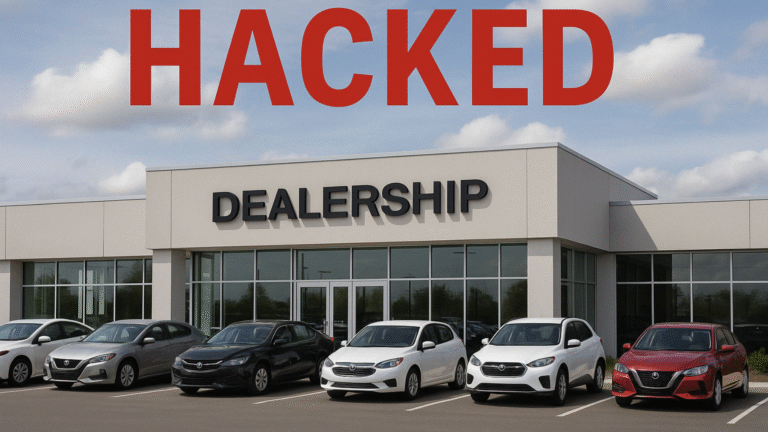
Car dealerships are increasingly becoming targets for cyberattacks. With large volumes of sensitive customer data, financial records, and digital infrastructure tied to both sales and service operations, dealerships are lucrative targets for cybercriminals. A single breach can cripple a dealership’s operations, cause massive financial losses, result in GDPR or data protection fines, and ruin customer trust.
Below, we explore the major cybersecurity risks for dealerships, real-world hacking cases, and the serious consequences of ignoring this growing threat.
Specific Cybersecurity Risks for Car Dealerships
Customer Data Theft – Dealerships collect and store sensitive information: names, addresses, social security numbers, credit scores, driver’s license scans, and financing details. A breach of this data exposes customers to identity theft and dealerships to massive legal liability.
Ransomware Attacks- Cybercriminals target dealerships with ransomware, encrypting entire systems until a ransom is paid. These attacks can halt operations, freeze access to vehicle inventory, service schedules, and CRM systems.
Phishing and Business Email Compromise (BEC) – Employees are often targeted with phishing emails that appear legitimate. One click can give hackers access to dealership networks. BEC scams have also tricked finance departments into wiring money to fraudulent accounts.
Vendor and Supply Chain Exploits – Many dealerships work with third-party software vendors for customer relationship management (CRM), vehicle tracking, or financing platforms. If a vendor is breached, it can give hackers indirect access to the dealership’s system.
Wi-Fi and IoT Vulnerabilities – From showroom Wi-Fi to connected diagnostic equipment and smart security systems, dealerships are filled with IoT endpoints. Many of these are poorly secured, creating easy backdoors into dealership systems.
Real-World Car Dealership Hacking Cases

Pendragon Group – UK (2022) – One of the UK’s largest car retailers, Pendragon, suffered a ransomware attack that affected its IT systems. The attackers demanded a $60 million ransom. The company refused to pay, but the attack caused operational disruptions and fears over leaked customer data.
Ken Garff Automotive – USA (2020) – Ken Garff dealerships were hit by ransomware that paralyzed internal systems. Customers couldn’t book services or contact the dealership properly. IT staff had to rebuild systems from backups, causing prolonged downtime.
Arrigo Automotive Group – Florida, USA (2018) – Hackers breached Arrigo’s dealership and accessed thousands of customer records, including personal identifiable information (PII). The breach led to investigations under Florida’s data protection laws, and the dealership faced potential lawsuits.
AutoNation – Suspected Breach (2021) – Although never confirmed publicly, rumors of a breach involving AutoNation, one of the largest dealership chains in the U.S., circulated after a known ransomware group listed them on their leak site. Even suspicion can harm a brand’s reputation.
Legal Risks and Fines from Data Leaks
Car dealerships face serious legal consequences if they fail to protect customer data. In both the U.S. and Europe, data privacy laws are tightening, and regulators are holding businesses accountable. In the European Union, dealerships must comply with the General Data Protection Regulation (GDPR), which imposes fines of up to €20 million or 4% of global turnover for data breaches. Even minor violations—such as storing scanned driver’s licenses without proper encryption—can result in penalties.
In the United States, dealerships fall under the Federal Trade Commission’s (FTC) Safeguards Rule, which mandates strict data protection measures. If a dealership fails to secure customer data—such as credit scores, personal identification, or financial records—they can face investigations, lawsuits, and civil penalties. Several U.S. states also have mandatory breach notification laws, requiring businesses to inform customers when their data is compromised. Delays or failures in notification can lead to additional fines.
Beyond government-imposed penalties, dealerships risk costly class action lawsuits from affected customers. These legal claims can result in settlements worth millions, not to mention long-term damage to the dealership’s reputation. In short, ignoring cybersecurity risks can turn into a legal and financial disaster for any dealership.
GDPR Fines (EU Dealerships) – In the EU, dealerships are subject to GDPR. If they fail to secure customer data and suffer a breach, they can face fines up to €20 million or 4% of global turnover—whichever is higher.
Example: A German automotive dealer was fined €140,000 for improperly storing customer license scans in unsecured systems.
U.S. State Laws and FTC Penalties – In the U.S., various state-level data breach notification laws apply. The Federal Trade Commission (FTC) can also penalize businesses under the Safeguards Rule of the Gramm-Leach-Bliley Act.
Example: In 2022, the FTC announced stricter Safeguards Rule amendments that affect auto dealers. Violations can result in civil penalties and lawsuits, especially after data breaches.
Class Action Lawsuits – Dealerships may also face lawsuits from customers affected by data breaches. Legal costs and settlements can quickly climb into millions of dollars, even if fines are avoided.
Conclusion: The Cost of Doing Nothing Is Too High
For car dealerships, cybersecurity is not just an IT issue—it’s a critical business risk. From ransomware that halts operations to legal fines and lost trust from customers, the consequences are severe. Implementing a robust cybersecurity solution that includes firewalls, employee training, data encryption, and endpoint protection is essential. With dealerships becoming digital hubs for financing, sales, and IoT services, protecting your data is protecting your entire business.






Add comment